Key Takeaways
Want to help? Whether you’re a financial institution, nonprofit, school, community connector, or donor — there’s a role for you. Get involved with Bank On San Diego →
The $40,000 Problem
$40,000. That’s the potential average cost over a lifetime of being unbanked.
When people don’t have a bank or credit union account, they typically rely on high-fee alternatives like check-cashing services, money orders, and payday loans that can easily drain $40,000 over a lifetime.
The cost may be even greater if you consider what that $40,000 could generate if it was invested over 40 years via a low-cost exchange-traded fund (ETF): $360,000 (source).
As costs rise, access to safe, low-cost financial tools becomes critical. Yet, right here in San Diego County, 13% of our community members (roughly 154,000 people) remain unbanked or underbanked.
Unbanked: There are approximately 5.6 million households in the United States that lack a bank or credit union account. Source
Underbanked: About 19 million households in the United States are underbanked, which means they use nonbank products like check cashing services, payday lending, pawn shops, or auto title loans to meet their core financial needs. Source
Living in San Diego County is expensive. The United Ways of California Real Cost Measure study shows that even though San Diegans are working hard, too many are still struggling to meet their basic needs.
The report shows a family of four in San Diego County with two adults, one child in elementary school, and one in preschool actually needs more than $116,000 annually just to meet basic needs. That’s the equivalent of three full-time minimum-wage jobs.
The Real Cost Measure also finds that:
- Almost HALF of San Diego County families with children under age six are not making enough to cover their expenses.
- On average, 97% of households below the Real Cost Measure in San Diego have at least one working adult.
- Approximately 70% of single-mother households in San Diego County are not meeting the basic costs of living.
With so many people struggling to meet even their basic needs, low-cost financial tools become especially critical.
What It’s Like To Be Unbanked

When you’re unbanked, payday looks very different. Without access to a bank or credit union, you’re often forced to rely on expensive alternatives like check-cashing services, payday loans, and prepaid cards, which are all loaded with hidden fees and high interest.
The first stop on the way home from work might be a check casher who takes a cut of your earnings. When the gas and electric bill is due, it might mean traveling to a big box store and paying another fee to load money onto a prepaid card.
Over time, paycheck after paycheck, these small fees add up to tens of thousands of dollars, money that could have gone toward rent, groceries, or savings.
Unbanked “cash only” households must rely primarily on in-person cash transactions and thus are at risk of theft or loss when handling their day-to-day finances (source).
Banking access is foundational to economic security. When people have access to equitable banking solutions, they keep more of their earnings, weather financial shocks better, avoid predatory lenders, and start building real financial stability.
Reasons People Are Unbanked
Research from the Federal Deposit Insurance Corporation (FDIC) in 2023 shows that there are many reasons people lack a basic bank or credit card account:
Unbanked Households’ Cited Reasons for Not Having a Bank Account by Interest in Having a Bank Account from the 2023 FDIC Report:
- Not enough money for the minimum balance
- Distrust of financial institutions
- Feelings that avoiding a bank gives more privacy
- High or unpredictable fees
- Don’t have personal identification required to open an account
- Credit or banking history problems
- Feelings that banks do not offer needed products and services
- Inconvenient locations or lack of accessibility in “bank deserts”
Much higher proportions of unbanked households that were not very or not at all interested in having a bank account cited “Don’t trust banks” or “Avoiding a bank gives more privacy” as reasons for not having an account, compared with unbanked households that were very or somewhat interested.
“Banks do not offer needed products and services” was more commonly cited among unbanked households that were not very or not at all interested in having an account.
In contrast, “Don’t have personal identification required to open an account” was more frequently cited among unbanked households that were very or somewhat interested.
The People Most Likely To Be Unbanked
In their 2019 survey, the FDIC stated that unbanked rates tend to be higher among certain segments of the population, namely households with low, volatile, or no income (the FDIC stopped asking about income volatility in its 2021 report). Education can also be influential, as people without a high school diploma were found to be more likely to lack a bank account.
According to the 2023 FDIC survey, unbanked rates remain disproportionately high for specific groups, including households with volatile monthly incomes, single-parent families, and working-age individuals living with disabilities. The data also highlights persistent barriers to traditional banking for families with less access to formal education, as well as Black, Hispanic, and Indigenous communities.
Some good news is that between 2009 and 2023, the unbanked rate among Black households decreased from 21.4% to 10.6% and the unbanked rate among Hispanic households decreased from 19.6% to 9.5%.
However, Black households remained overrepresented among unbanked households, comprising 12.9% of households overall but 32.3% of the unbanked in 2023 as well as Hispanic households, which comprised 14.8% of households overall, but made up 33.4% of the unbanked. (source).
The Bank On San Diego Coalition: Building an Ecosystem of Support
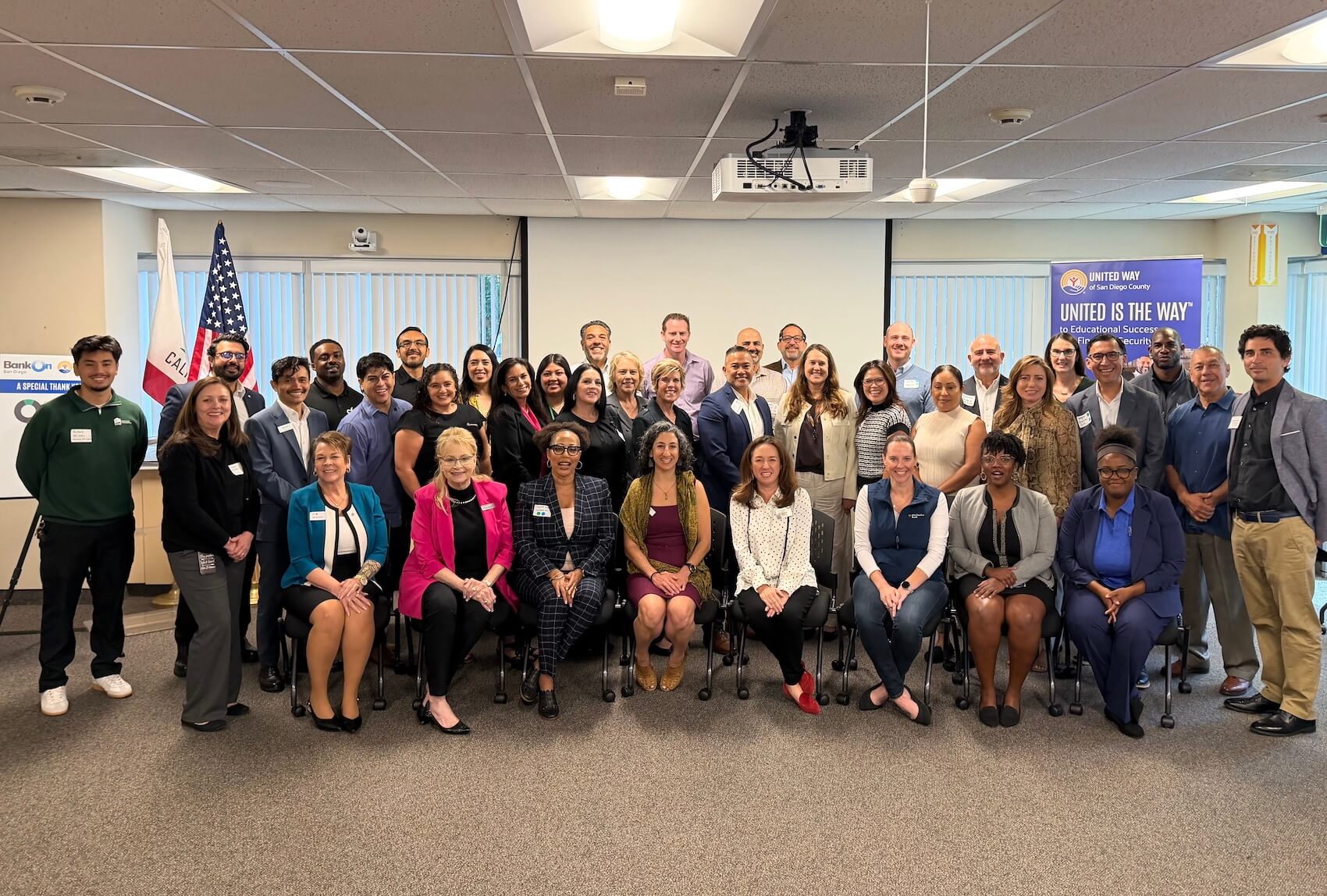
No one should lose $40,000 over a lifetime because they lack a bank or credit union account. That’s why United Way of San Diego County (UWSD) leads the Bank On San Diego Coalition, a partnership between financial institutions, nonprofits, government partners, and community leaders to share local data and identify concrete actions to expand banking access across the county.
The Bank On San Diego Coalition leverages resources and expertise to:
- Implement financial literacy education programs.
- Promote safe, accessible, low-cost financial products and services.
- Conduct outreach to underserved communities.
- Help San Diegans take control of their money.
How United Way of San Diego County Is Serving the Community
Collaboration requires trust, transparency, and coordination, and creating the space for these relationships to grow is one of United Way of San Diego County’s most important roles.
UWSD is honored to be one of five organizations selected for a national Bank On Fellowship, supported by the Cities for Financial Empowerment Fund (CFE) and the Wells Fargo Foundation. Through this fellowship, UWSD’s Nina Ghatan serves as our two-year fellow, working alongside our 23 current partners across financial institutions, nonprofits, and regulatory agencies.
Together with our other initiatives, such as the San Diego County Earned Income Tax Credit (EITC) Coalition for free tax prep and tax credit help, SparkPoint financial coaching, and local education programs and partnerships, we are building a continuum of support, putting money back into hardworking families’ pockets and providing the banking access needed to keep it there.
The Standard: Bank On Certified Accounts
Not all financial products are created equal. The CFE Fund has created national standards to ensure accounts truly serve the people who need them most. Nationally, there are over 500 financial institutions with certified accounts.
In San Diego County alone, we’ve built a network of 23 local financial institutions that offer Bank On certified accounts that are:
- Safe: Designed to prevent negative balances. If a transaction exceeds the available funds, it is simply declined, preventing overdraft fees.
- Affordable: Featuring no or very low monthly maintenance fees.
- Functional: Providing full digital access via online portals and mobile apps, physical branch access, direct deposit capabilities, and online bill pay.
One of our goals over the next two years is to help five more local financial institutions achieve Bank On certification.
Identifying the Gaps: Banking Deserts
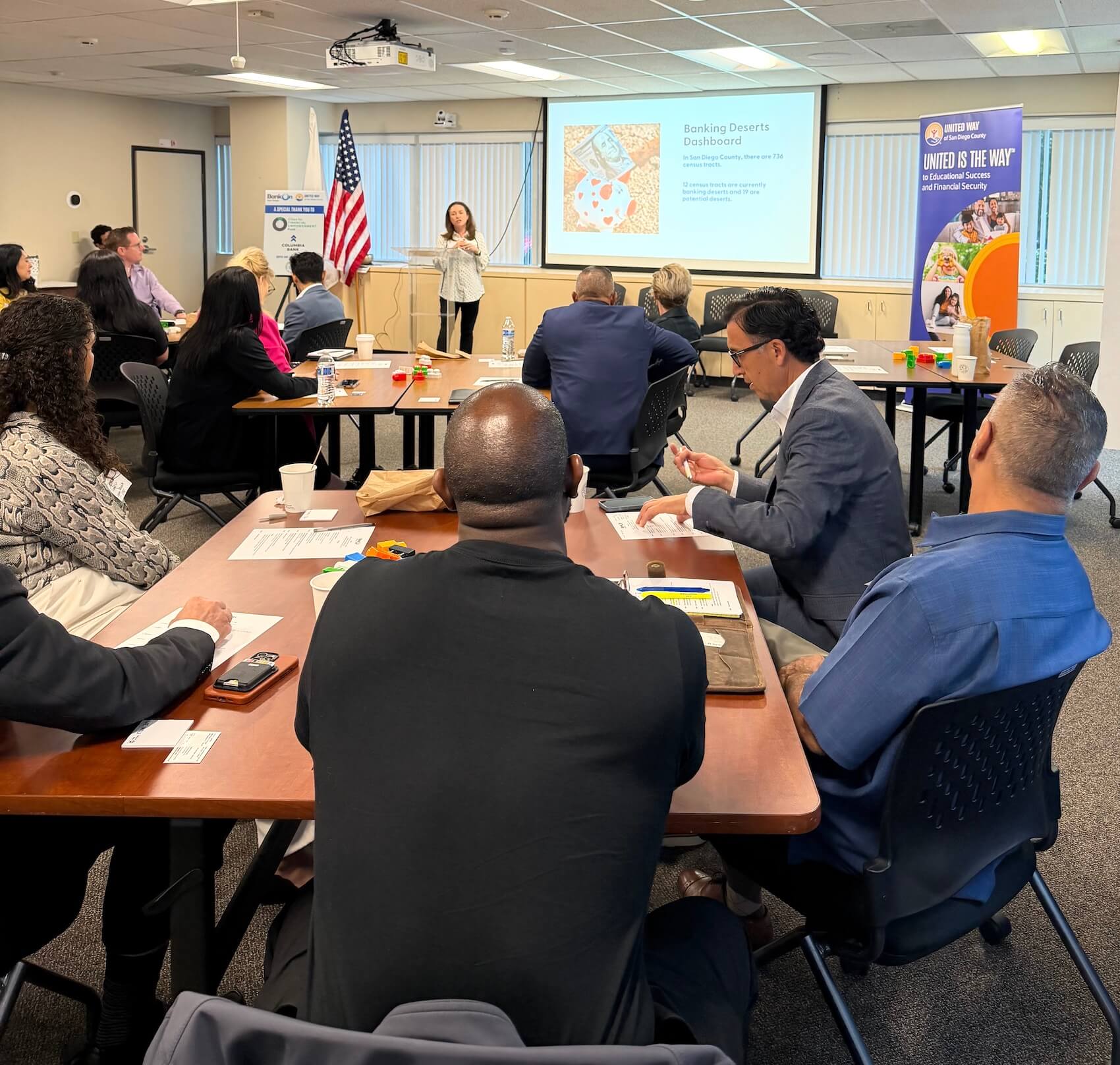
Expanding access requires knowing exactly where the gaps are. During our recent 2026 Bank On Forum, we were joined by Jessica Coria, Senior Outreach Manager for Southern California at the Federal Reserve Bank of San Francisco.
Jessica walked coalition members through the newly updated Banking Deserts Dashboard (released in November 2025). This powerful tool highlights exactly where banking deserts exist in San Diego County, which communities are most impacted, and how access to physical branches and digital tools varies by geography.
While quantitative data like this dashboard is a crucial piece of the puzzle, lived experience, local context, and community voice are equally important. Trust matters. That is why integrating banking access directly into existing, trusted community programs is far more effective than relying on flyers or one-time referrals.
Real-World Integration to Banking Access & Financial Literacy
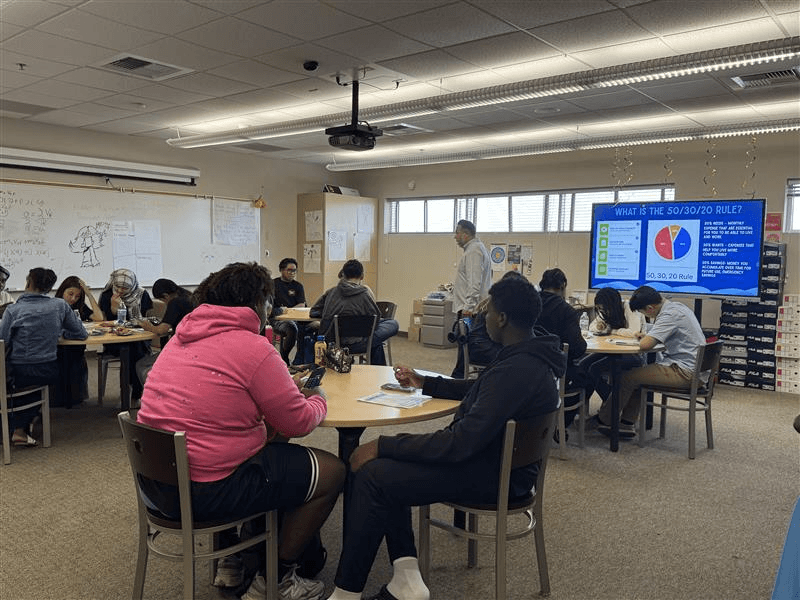
To meet people where they are, we must weave banking access directly into the fabric of our community programs. A prime example is UWSD’s Dream with STEAM program.
This 4-week summer career exploration program introduces high schoolers from under-resourced communities to high-paying, in-demand careers while building financial readiness. Students who complete the program earn a $1,000 educational award, creating a natural opportunity to pair income with financial education and account access.
We integrate this process seamlessly from the very beginning. As soon as students are notified of their acceptance, they are informed of the opportunity to open a Bank On certified account at orientation and told exactly what documentation they need to bring. On orientation day, we provide dedicated time for students and caregivers to enroll in Bank On certified accounts onsite, utilizing QR codes for easy digital setup.
As they move into weekly programming, students receive one hour of financial education every week from Cal Coast Credit Union. During those early sessions, a financial institution partner stays onsite afterward to facilitate any additional account openings. We also facilitate classroom activities in which students create social media content about their financial literacy journey, enabling them to educate their peers. Finally, at the capstone celebration, students present their projects and share program highlights, reinforcing their newly acquired financial readiness skills.
By making account openings and financial education a seamless part of the program design, we bypass the need for traditional advertising and build immediate trust.
Another one of our goals is to build four similar banking integrations across the county over the next two years.
Empowering the Next Generation
It is not just about getting people to sign up for Bank On certified accounts; it is about equipping them with the tools to succeed.
In 2024, Governor Newsom signed AB2927 into law, requiring all high school students attending public and charter schools to complete a standalone personal finance course to graduate (beginning with the class of 2030). To discuss how we can capitalize on this momentum, UWSD moderated an expert panel during the 2026 Bank On Forum featuring:
- Croquette Hudson, Director of Business Development, California Coast Credit Union
- Pana Hap, Vice President of Programs & Policy, Junior Achievement of San Diego County
- Patrick Della, Community Manager, JPMorgan Chase
The consensus was clear: it is never too early to equip students with the tools to make informed financial decisions that will shape their entire lives.
While San Diego boasts lower unbanked and underbanked rates than many other major regions, a significant gap remains. Access to an account is only the first step; many local families still feel a disconnect between simply having a bank account and feeling truly empowered by financial education.
That is why taking an upstream approach, by reaching young people before they ever navigate the complexities of adult financial systems, is so critical. By instilling strong financial literacy and confidence in high school, we can prevent financial missteps before they happen. On an individual level in our community, this is how we shift the narrative from basic financial survival to long-term wealth building, giving San Diego County’s youth the agency to break generational cycles and build lasting financial security.
How You Can Get Involved
The solutions exist. Our role now is to connect people, resources, and ideas to create clear pathways to financial security. Here is how you can take action today:
- Financial Institutions: If you are interested in exploring Bank On account certification in San Diego County, please reach out to us.
- Nonprofits, Schools, and Public Agencies: If you want to integrate banking access and financial education into your existing programs (like workforce training or VITA tax sites), let’s talk. We are eager to explore opportunities.
- Community Connectors: If you have relationships with financial institutions not yet involved, or community organizations working within banking deserts, your introductions can make a meaningful difference.
- Donors: Your support unlocks scale. Whether you want to support coalition coordination, pilot new program integrations, or invest in upstream financial education, your partnership is vital.
Together, we can break generational cycles of inequity and ensure all San Diegans have the tools they need to thrive today and in the future.